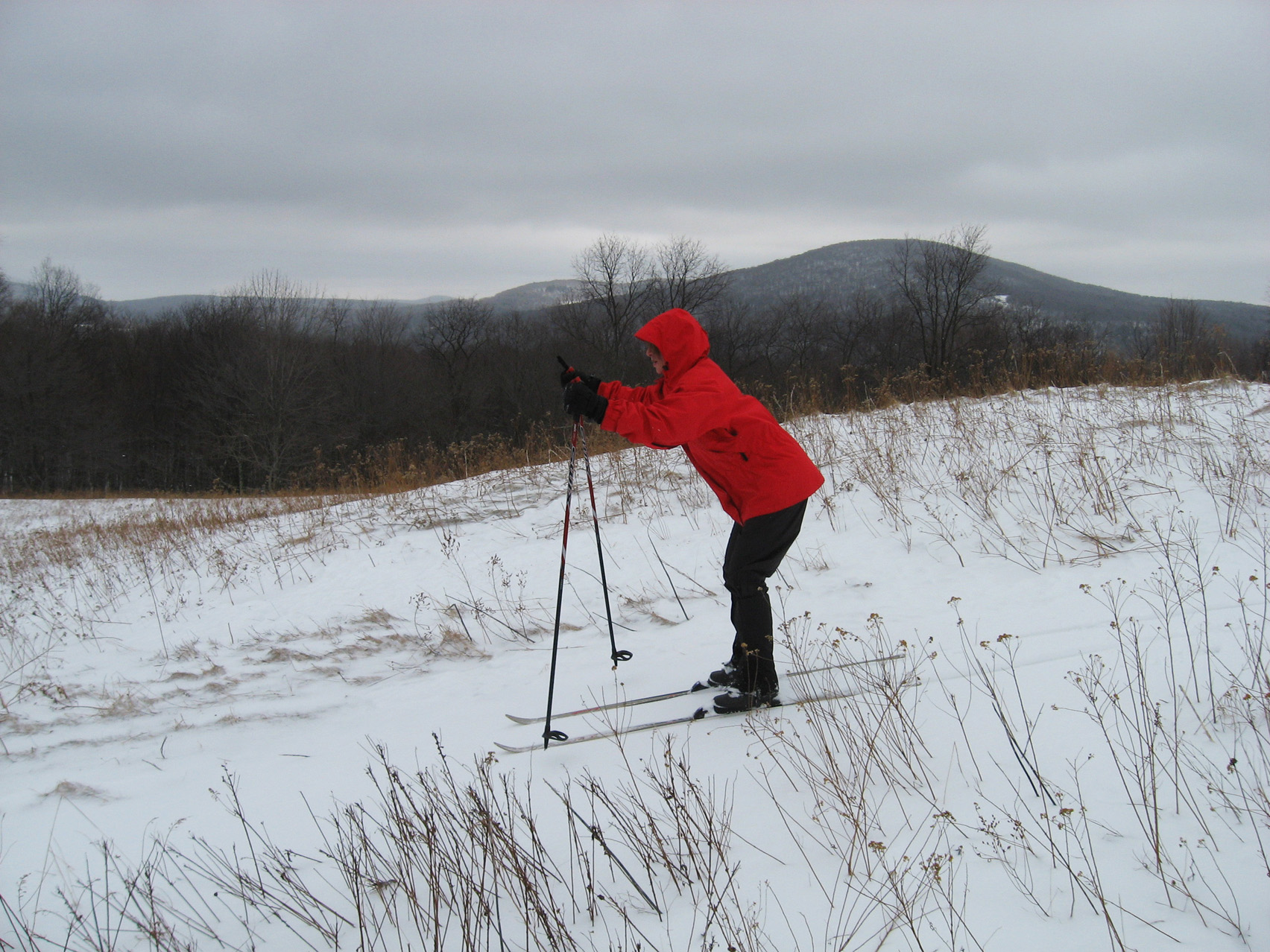
Deb skis the backcountry. 2010
As I have mentioned in earlier posts, I love to cross-country ski and bought land where I could do it. This has been an amazing winter for backcountry skiing.
The best ski conditions for backcountry skiing locally are these: You need a good base, like two feet of snow; then you need some warm weather and even rain to compress the snow; then you need it to get real cold again, crack cold, for the surface to freeze, giving you a hard, smooth surface for the new snow to sit on. This base should be strong enough to walk on with your boots and for the most part not break through.
The next thing you need is a snowfall of at least 2 inches, or up to 10 inches if it is cold, fluffy snow. With this under you, you are good to go anywhere your skiing ability can take you. No trails, no tracks just you. Sweet! In these conditions, you don’t need any grooming or broken trail (previously skied) because the snow is light enough to allow you to glide effortlessly, but also gives enough grip to turn or stop. You can even go night-skiing with a headlamp–or moonlight–and not worry about staying on trail.
Having described these ideal conditions, the reality is that, during most winters, they present themselves only momentarily–and usually not when you are available to go skiing. This winter–from most of January on– the conditions have been ideal. We only had one heavy, two-foot snowfall, but that was the one that thawed and then froze. Since then, we’ve had other thaws and rains, but always followed by a freeze and 3 to 5 inches of light snow.
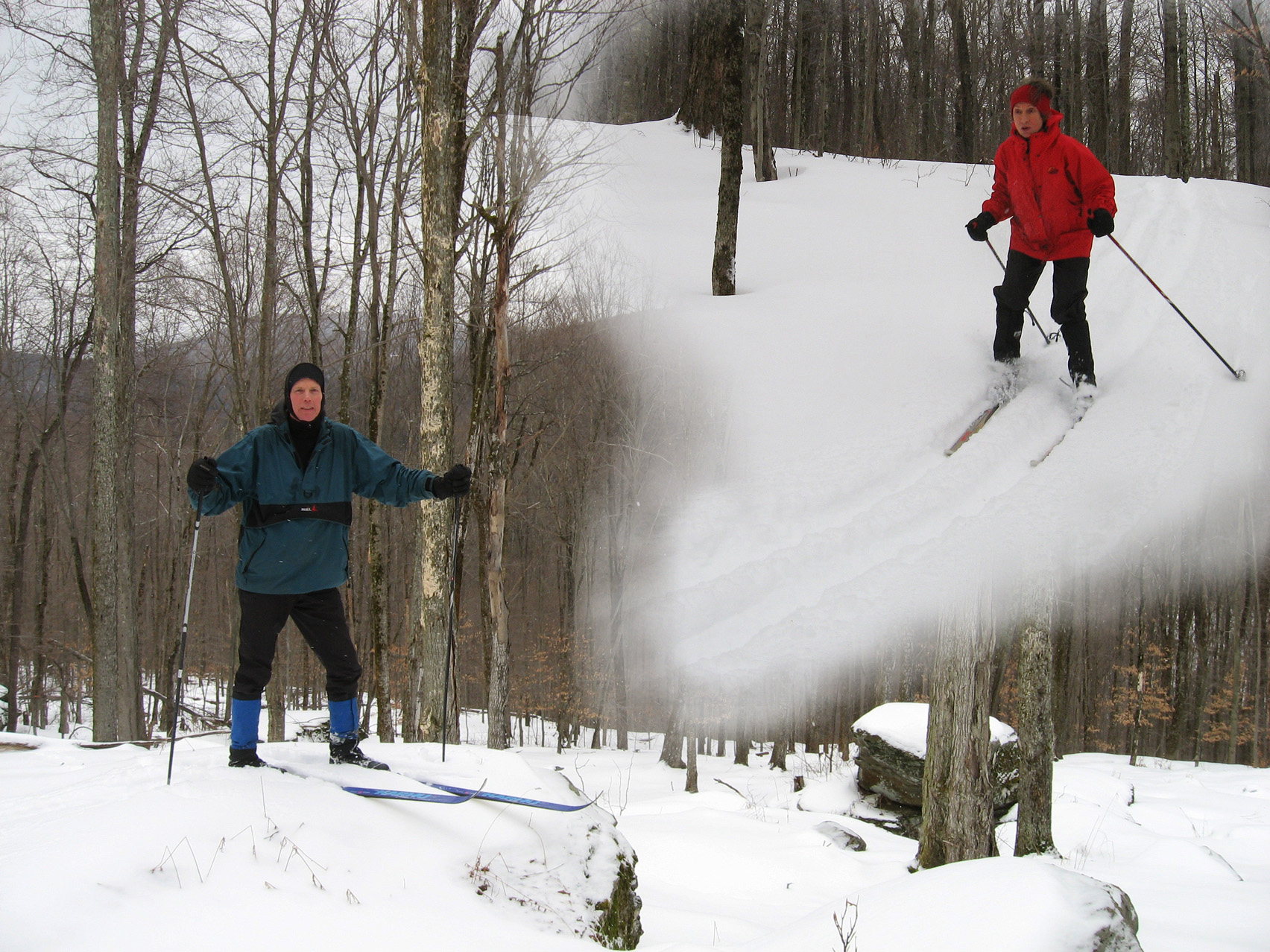
Deb and John on our private mountain ski trail. Feb. 2010
In the Northeast you just can’t go out in the woods and x-country ski, especially in a Northeastern hardwood forest. Storms are always blowing down branches and trees. You may start out on what looks like a trail but you will soon be frustrated and run into a tangled mess.
So after a few winters of doing this, I developed a trail that sort of circles part of the mountain we live on. It starts and ends on our property but travels through neighboring property. It was a lot of fun discovering the route, making it visually interesting and challenging, but also safe.
The amount of work needed to clear it was also a consideration. The Western side of the trail is easier and safer and the eastern side is more challenging. So when ski conditions are an issue we usually take the Western half of the trail, that side also has the vista in the top photo. Maintaining the trail is a big challenge.
I usually go in before deer hunting season and clear most of it. There are always several places where a tree has fallen down and blocked the trail. Then after deer season, if the snow isn’t too deep, I try to walk it one more time with my chain saw. The upside to clearing the trail is good physical conditioning for the upcoming ski season. It is a lot of work– all for the pleasure of having an unimpeded ski through the wilderness!
Along with removing the forest litter, the problem with backcountry skiing in the Northeast is breaking trail. After a heavy snowfall, skiing our backdoor trail system can take two hours of hard slogging. We do it for the exercise challenge as well as the love of being outdoors in the cold winds and heavy snowfalls. We don’t do that hard slogging it for the love of skiing– because we aren’t skiing.
On the other hand, during perfect conditions–such as shown in these pictures–you can complete the trail in just under an hour.
I am not a big fan of x-country ski centers because you have to travel to get to them and then pay. Backcountry skiing –which is what we do out our backdoor –is usually harder in that you have to break trail. The downside to backcountry skiing is that, without a groomed trail, you don’t often achieve that classic “kick and glide” rhythm that is particular to cross-country skiing. But there is a plus side for a heavy snowfall on an unbroken trail–going down hill. Unlike alpine skiing, cross-country skiing down a steep slope is tricky, if not treacherous, due to the speed factor, the lack of heel bindings, and the difficulty of controlling the skis. But when you’re slowed down with all that thick powdery snow, you can ski down steep slopes. This is a big rush for me, but also a big workout.
Since 1995 when I first bought our property, there has not been a winter when I couldn’t ski at all. Keep in mind we are traveling back and forth from the city so our presence in the woods is intermittent, but I remember one winter that we didn’t ski till the end of March. Then there have been winters where it would snow heavily, so we would break the trail over our three days there, only to come back the next weekend and have to do it all over again! Then there are the times when we get the trail broken nicely and it thaws, rains and then freezes like hell — but doesn’t snow.
Not being able to get out and enjoy the weather and the country is a huge disappointment for me. So I’ve come up with the answer to the question of how to extend the ski conditions — using a snowmobile for trail-breaking. I was bound and determined to get a used one this winter, seeing as how I had a new garage to store my toys, but I ran out of money. November 2009, deep in Recession territory, was my worst month ever in 20 years of freelancing, so the toy was not realized.
Back in Chautauqua County where I grew up and first started skiing, I used to hate skiing on snowmobile tracks. The problem is not the drive belt but the steering skis of the vehicles, they make ruts. Hence, cross country skiers are always trying to avoid them. These ruts cause more wear and tear on your joints, and cause you can to cross up your skis and trip if you don’t concentrate.
So why a snowmobile if I hate the tracks so much? I want to make a drag sled to tow behind it. This will even out the trail for x-country skiing, I believe.
Fortunately, the winter of 2009-2010 has not been the kind where a snowmobile is needed to kick and glide!
Back in the days when I skied in Chautauqua County, we didn’t need a snowmobile to break our trails because there were always other skiers using the trails, keeping them open. Snowmobiles weren’t even allowed on the part of the Overland Trail (county property) we loved.
Here in the Catskills, no one else knows about my private trail in the mountains and even if they did I doubt if people would use it and help keep the trail broken. It is too out of the way and most people don’t want to work that hard.
Speaking of working that hard, that’s why x-country skiing has a bad rap. Too much work, “Isn’t it like hiking?”
I saw a notice in the paper about a local x-country ski club and I thought it would be interesting to hook up with them. It turned out to be a fun day, weather wise we got about five inches of snow during the outing and they were enjoyable ski lovers. But they weren’t backcountry skiers. Every weekend they go to a different trail but these trails are the same ones used by snowmobiles.
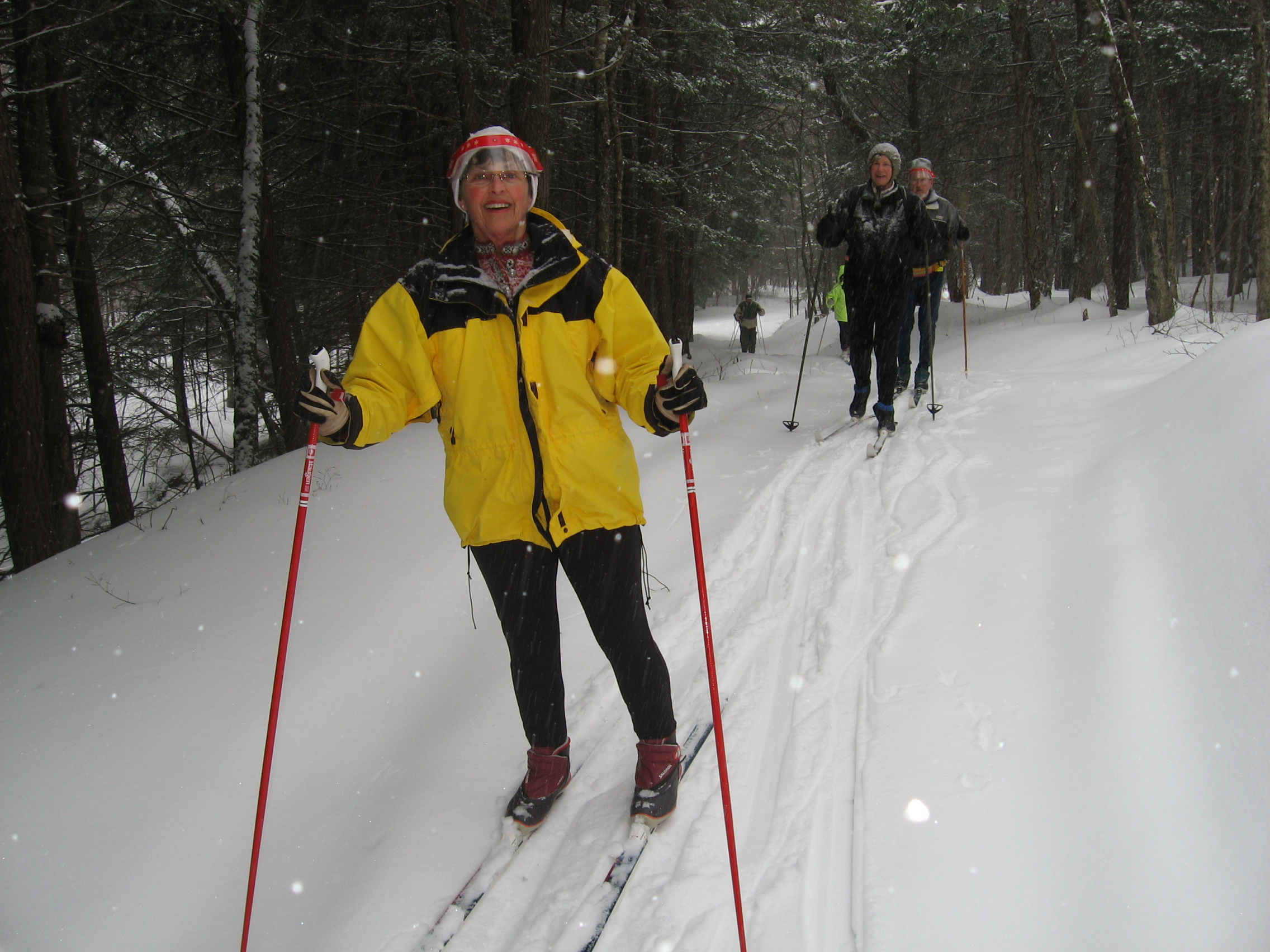
Cross Country Ski club.
The leader and organizer was a retired school teacher who coached the local high school x-country ski team. Everyone was over 40, they were all mostly dressed in ski racing attire, tights, light narrow skis and no gaiters. A couple of times I left the trail to explore and no one followed. It is foolish not to wear gaiters when you ski like this, my companions all came back to the start with snow packed around their ankles in their ski boots. My feet were dry and warm as could be.
This group is social. Each week someone is responsible for providing refreshments at the end. We had coffee or tea and a variety of delicious desserts. I was hoping to introduce them to my private trail but wasn’t sure about their mindset in regard to the spirit of backcountry skiing. I do know that my trail is very interesting with some nice vistas, a variety of terrain and some very cool downhills. In the future I would like to revisit this group.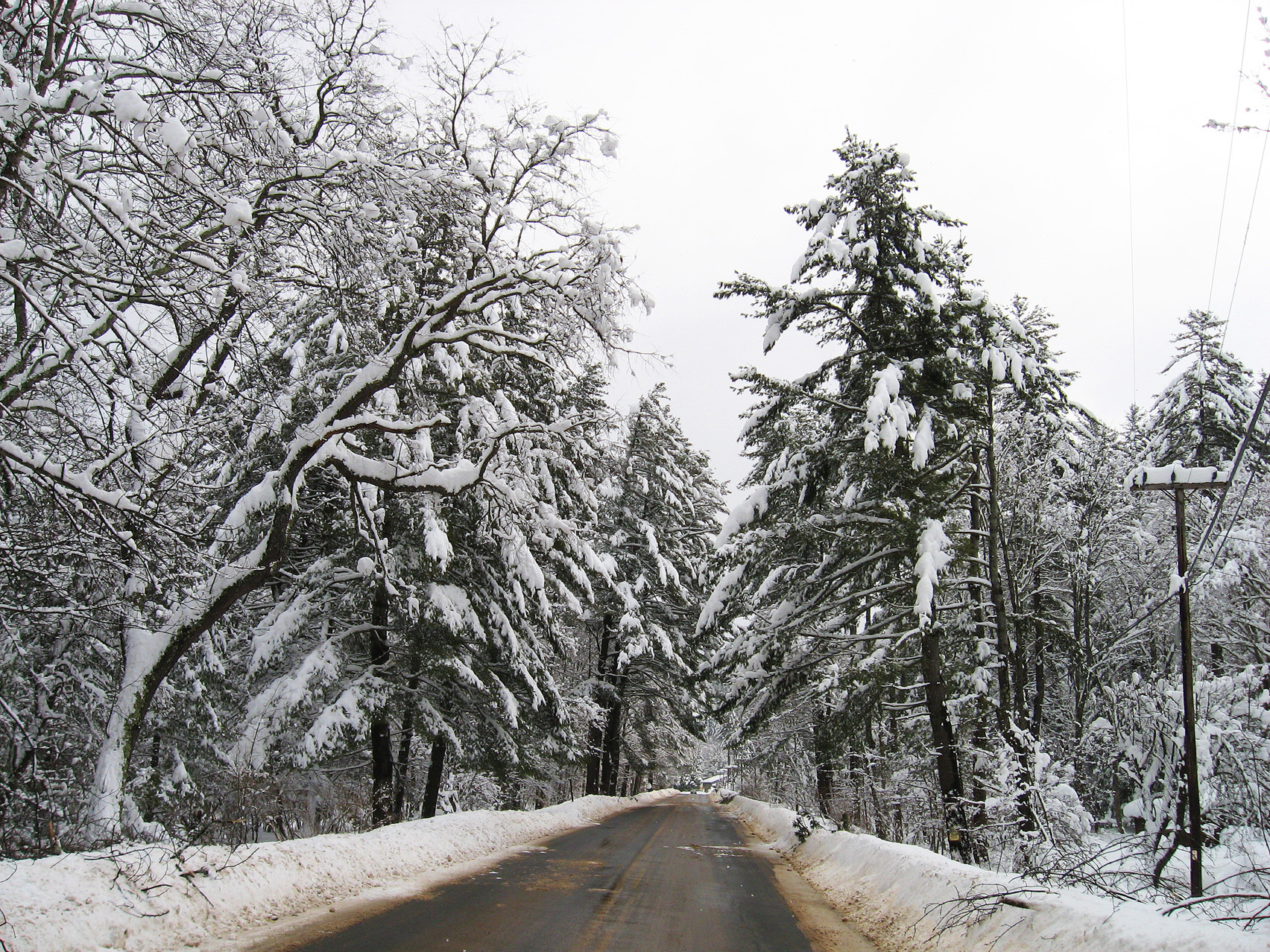
So much for those great x-country ski conditions. The last week of February we had over 40″ of snow. I went out and slogged around–tiring, but yes, beautiful. I have been telling myself to get those snow shoes. This was the perfect storm for them. Buy a used snowmobile for $2,000 or spend $125 for an average pair of snowshoes and break trail with those. Hmm…. what should I do?
Afraid to see what trees have fallen over and clogged our trail. The power was out for over five days.
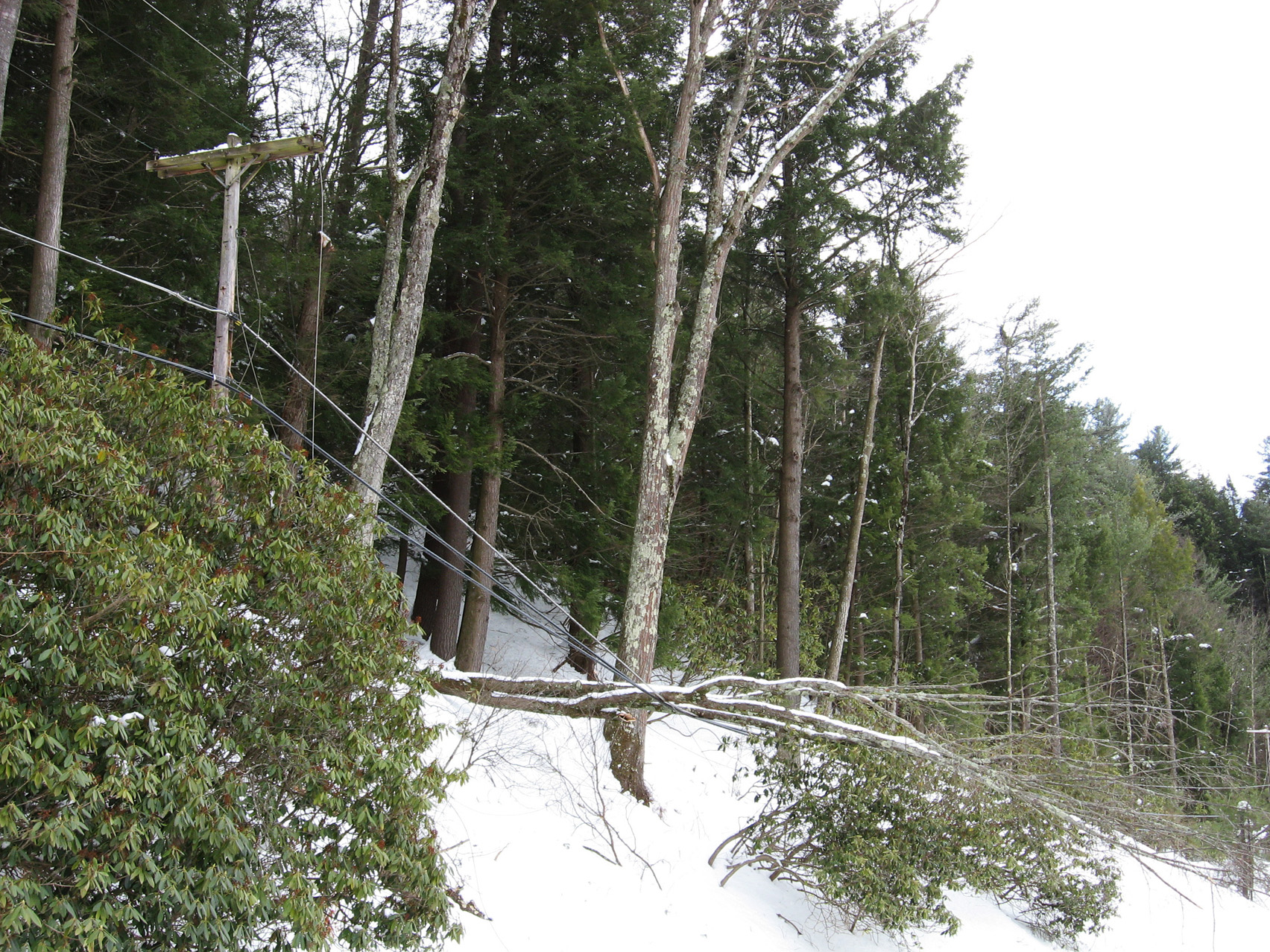
Downed power line.